My Thoughts on Split Share Corps
I don’t know if this is a Canadian invention, but there is a type of investment mutual fund called a split share corp.
The basic idea is that the investment fund raises money by selling to the public two classes of shares with different rights:
- A common stock that only pays a (usually high) dividend under certain circumstances
- A preferred stock that always pays a dividend
For instance, in one example below, the common stock was originally sold to the public at IPO for $15 per share on its debut, and the preferred share sold for $10. Split share corps also have a built-in end date when the fund’s assets can be returned to investors, although it is usually extended.
The funds raised are then used to buy income-yielding stocks like banks, financials, oil and gas, etc.
One example is “Dividend 15 Split Corp” by a fund manager named Quadravest.
There are others on the market, but this is the one we will look at since it’s very popular.
Dividend 15 (DFN.TO and DFN-PA.TO tickers) currently has around CDN$1.75 billion under management and invests in 15 dividend-yielding, high-quality Canadian companies. DFN is scheduled to end in December 2024. But, like I said, it’s usually extended.
The net asset value of the preferred shares is set to $10 and never changes because when the fund ends, the preferred investors only get $10 per share back. So, the preferred shares usually trade somewhere around $10. They do not benefit from any rise in capital gains of the underlying holdings and pay a fixed dividend of 5.5% per year.
The common shares try to pay an 8% dividend, but the net asset value of those shares fluctuates with the underlying stocks. If the net asset value of the entire fund falls below $15 per share, the common stock stops paying a dividend until it returns above $15.
Does it sound complicated? It is, and that’s the first red flag for these things. This mutual fund is not the same as an ETF, although people might consider it an ETF. A split share fund can trade at a premium (or discount) to its true value because the NAV is public and regularly updated.
I don’t recommend investing in split share funds.
Here are my comments on Split Share funds in general (and Dividend 15 in particular), in no particular order:
- DFN.TO is currently trading for around $3.80 per share, which happens to be below the ~$5 point at which it pays dividends. So, investors have been holding this stock and not earning any income for the last three months. Did you need that income to pay rent?
- Remember that DFN.TO was sold to the public at IPO in 2004 at $15 per share. It’s trading at $3.80 and holds Canada’s top 15 dividend-paying companies! So, some “nav erosion” has occurred over the years. These companies are all individually up 500%+, and the fund that holds them is down 72%!
- In its defense, DFN has paid out to investors more than 100% of what it raised in the IPO, so if you bought it at the IPO, you have been given more than your money back over the years and still own the shares. But of course people who have held this for the first 20 years are fine. What we’re thinking about is the next 20 years.
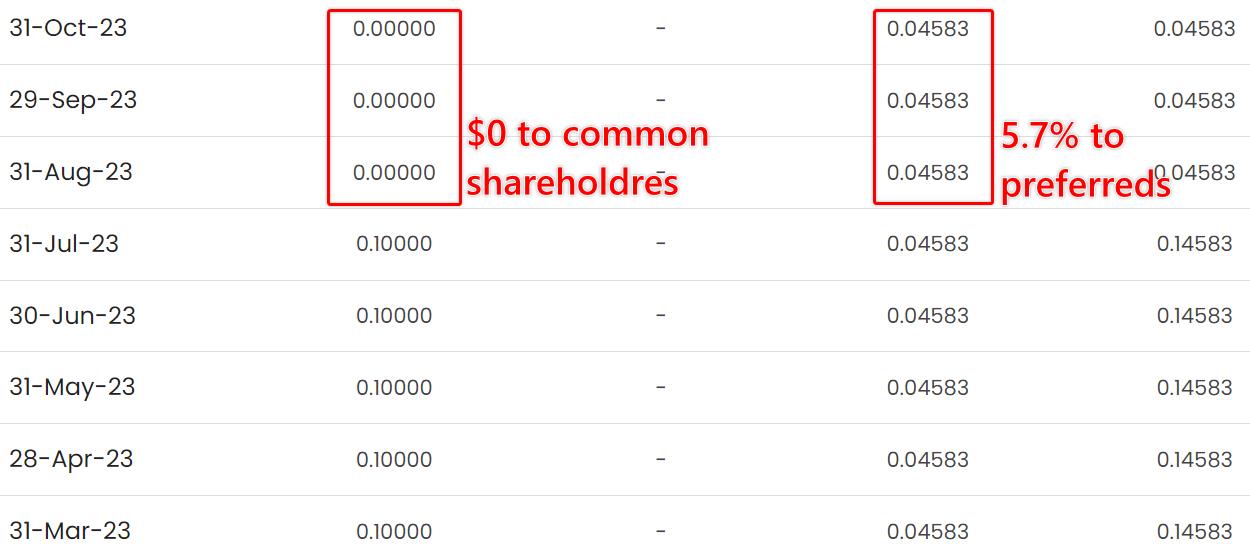
- I calculated that the fund earns about 5.8% per year in income from its holdings (according to the last semi-annual report) and pays out 5.7% to the preferred share investors. So, Preferred Share investors are currently capturing nearly 100% of the monthly income leaving none for the common shareholders. If any big company (the Big 15) cuts or pauses its dividend, the NAV is in trouble. What are the chances of any of those companies cutting dividends in this economy? Not zero.
- The common shares rely entirely on the holdings gaining in value to return to the $5 mark. The common shares need to gain 31% just to be eligible to pay one dividend.
- Every time the common shares pay dividends, the NAV drops by the same amount. So if DFN gets to $5.05 to pay its $0.10 monthly dividend, it immediately drops to $4.95 and is not eligible to pay it the following month.
- Do you see the trap? The holdings need to gain a lot to pay the dividend and then continue gaining to continue paying the dividend. It’s like salmon swimming upstream in order to mate. There is a constant strong push against their progress.
- The one piece of “good news” is that this split share structure allows the common shares to “leverage” the preferred shares investors’ money. So, one share of DFN ($3.80) gets you $13.80 worth of shares. That’s around 3.6:1 leverage. DFN needs to increase by 31%, but the underlying stocks only need to increase by 10%.
There’s no way to predict the future. However, it looks like a difficult, uphill battle for split share stocks.
DFN.TO is down 45% in the last 6 months. And 63% over the past 10 years.
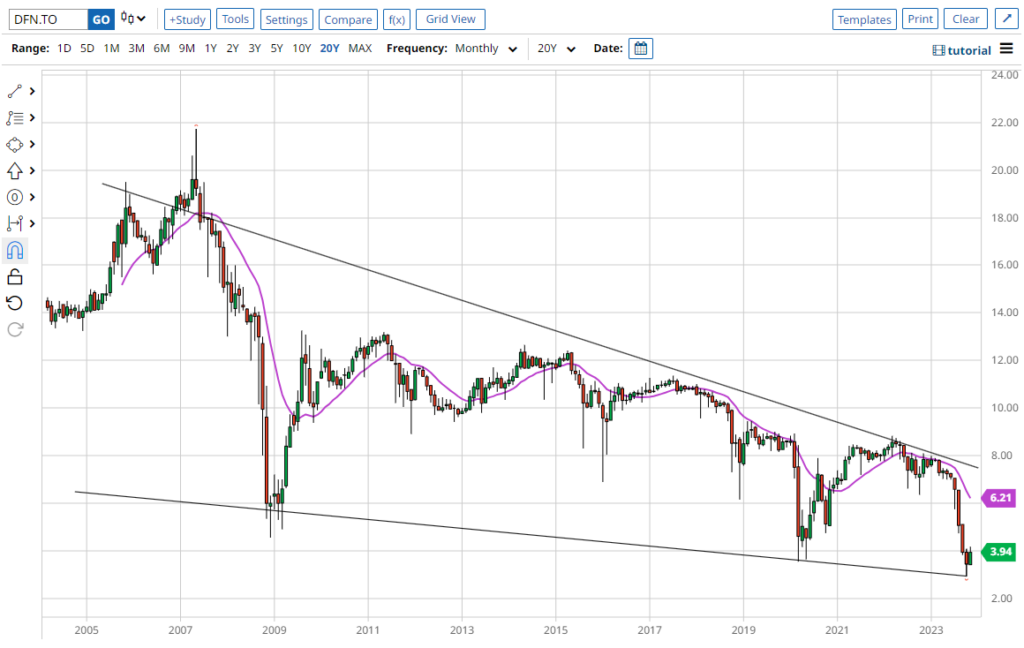
The fund seems “designed” to go down in value over time. It shows a continuous trend of going down in value over the past 20 years. So, in 2023/2024, how can investors sit idle and wish for it to go from $3.80 back to $7.00 (where it was earlier this year)? It’s rarely shown such a move in the past 20 years.
If you were bullish on the stock, it would be easy to look at the stock holdings and say, “Just wait, all these great stocks will go up!”
But all of these great stocks HAVE gone up over the past 20 years (500%+ each), and look at the chart of DFN over that time! 20 years of proof that the stock holdings are not related to the mutual fund’s price.
So, I don’t get split share corps. I don’t understand HOW they are expected to go up. It’s such a strong downward pressure to keep the price going down. It’s like a ratchet. It’s very easy for the stock price to go down and very hard for it to go up.
I don’t like investing in funds like that.