Down to 22.5% Cash
In the last couple of days, I’ve decided to push some more money into the market in a very conservative way. Extremely conservative.
I put 13.5% of my portfolio in Canadian ultra-short-term bonds using the BMO Ultra Short-Term Bond ETF (ZST).
BMO Ultra Short-Term Bond ETF has been designed to provide exposure to a diversified mix of shortterm fixed income asset classes with a term to maturity of less than one year or reset dates within
BMO website
one year.
This ETF is invested in Canadian corporate and government bonds with less than one year til maturity. I feel this short-term nature gets me some higher interest rates. Currently, it’s yielding 4.69%. That is relatively safe money as long as rates don’t go much higher from here. The Bank of Canada has indicated a pause in rates for the short term, and inflation has been coming down.
The 6.8% of my portfolio invested in the BMO Money Market Fund ETF (ZMMK) is an even safer investment.
This fund’s objectives are to preserve the value of your investment and to provide a high level of liquidity and interest income.
BMO website
The Money Market fund never has a loss. It’s basically going to be worth $50 (more or less) forever, and will kick off its income to investors every month. There’s a bit of a zig-zag pattern in the stock chart because the fund gains value every day until the ex-dividend date, and then it resets.
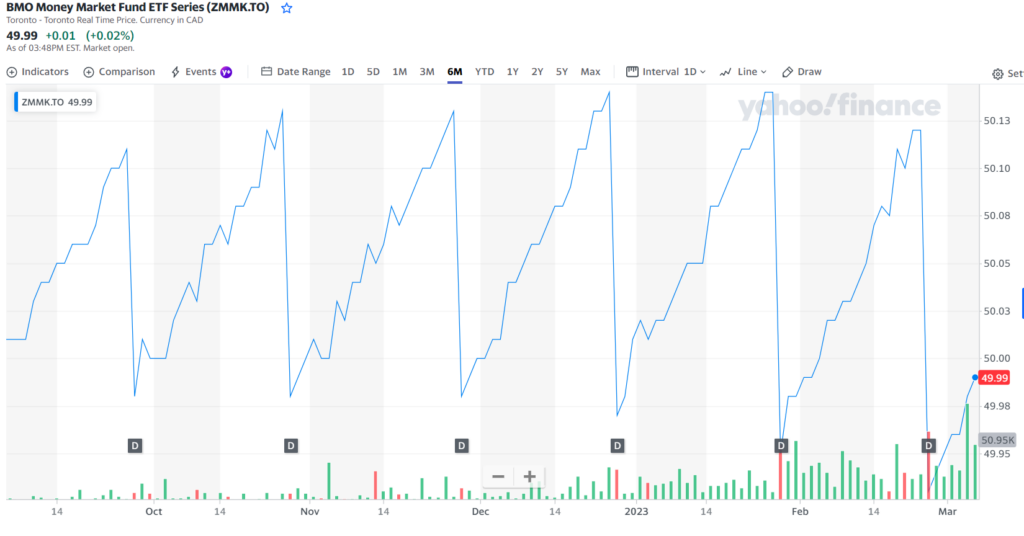
This fund is currently yielding 4.78%. That’s amazing, actually. Almost the safest money you can have at 4.8%. Probably similar to a GIC. The problem is the trading fees I pay ($9.95) to get into and out of it. So I have to ensure I’m trading in big enough volume.
So the government bond fund is yielding 4.68%, and the money market fund is yielding 4.78%? Not bad.
Altogether I have a good 20% of my portfolio invested in these two short-term “fixed-income” investments.
I have another 15% of my portfolio in other fixed-income funds with closed-end funds like PIMCO, Invesco, and DoubleLine. Those are riskier funds, often B- and C-rated bonds. I should consider reducing my exposure to riskier bonds if this recession really does come true.
My goal was to only be in 10% cash. I’m currently at 22.5%.
I might be able to get another 2.5% from cash into a fixed-income fund, but to go lower is a bit difficult.
Most of the rest of my money is in Europe, and I’ve not been happy with the fund selections here. Interest rates in Europe have been mostly negative for the past many years, and the EU has only recently raised rates out of the negative zone to +3.0%. Compare that to the US Federal Reserve, which set rates at 4.75%, and the Bank of Canada which set rates at 4.5%.
As well, most European ETFs pay annually, semi-annually or quarterly. There are just no monthly payers that I can see.
So, as a result, a Euro money market fund pays only 0.55% compared to the 4.8% of the Canadian equivalent.
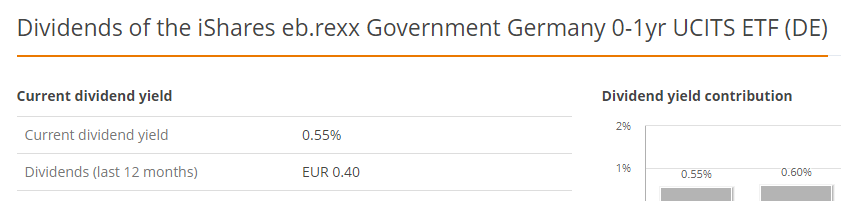
It’s hardly worth the broker fee for buying this thing. And the stock itself goes down every year, so the total return has always been negative.
I don’t know what to do about this problem. Where do Europeans invest their money to get any return safely?
I might be stuck with 20% cash until I can fix this issue. Either I have to invest in riskier stuff, or move my money back across the pond to Canada to invest. I’ll have to do more research on that.
I might soon consider myself fully invested.
I should also make a point to see if I still like some of the riskier investments I’ve made over the past year. It seems that people are starting to accept that interest rates will be “higher for longer,” and things will start to break. Perhaps another crash in stocks. Perhaps a spike in bad mortgage loans. It’s a bad time to be owing other people money unless your rates are locked in.