
My Top 5 Largest Holdings
I haven’t considered this for a while, but let’s look at my current top 5 holdings and see what I like about them.
I will ignore the Money Market ETF, BMO Money Market Fund ETF Series (ZMMK.TO) for this list. This is just earning a bit of interest on my cash and is not a long-term investment. Plus, my intention is for my cash holdings to go down. I hold a significant amount of this fund, but I won’t include it on the list.
#5. iShares Core Dividend Growth ETF (DGRO)
My fifth largest holding is iShares Core Dividend Growth ETF (DGRO). I never really heard of this ETF before, so I never gave it much consideration. But when I found out about it, I liked its strategy. To be considered for inclusion in this ETF, a stock must:
- Pay a qualified dividend
- Not be a real estate investment trust (REITs have special tax treatment)
- Exhibit a 5-year history of increasing their dividends (usually a good sign of increasing profits)
- Have expectations of positive earnings growth by analysts (also a good sign)
- Pay out no more than 75% of their earnings as dividends (the dividends are sustainable)
- Not be in the top 10% of dividend payers (not a dividend trap)
Then, the remaining stocks are weighted based on market cap and dividend yield. This leaves some big companies that reliably pay dividends as being among the top holdings. There are 433 holdings as of the time of writing.
The 1-year return has been 11%, and the trailing yield has been 2.3%.
I like this fund primarily because it puts the stocks through particular filters on their ability to pay and are expected to be able to pay into the future.

4. Vanguard Total World Stock ETF (VT)
My fourth-largest holding is VT. This holds every publically traded company in the entire world. That’s currently 9,570 stocks.
FTSE describes this index as large, mid, and small caps. So this makes this fund slightly different than my top holdings, which I haven’t mentioned yet. 🙂
The theory here is that a fund such as this is invested worldwide. 60% of the holdings are in the US, but it also holds stocks in UK, Japan, Europe, Australia, Canada, and others. It holds every company.
The 1-year return has been 12.62%, and the trailing yield has been 2.1%.
There is no filter on this. This is every stock. Any company I see that has a stock, I own some small amount of that. This is as passive as passive income investing gets.
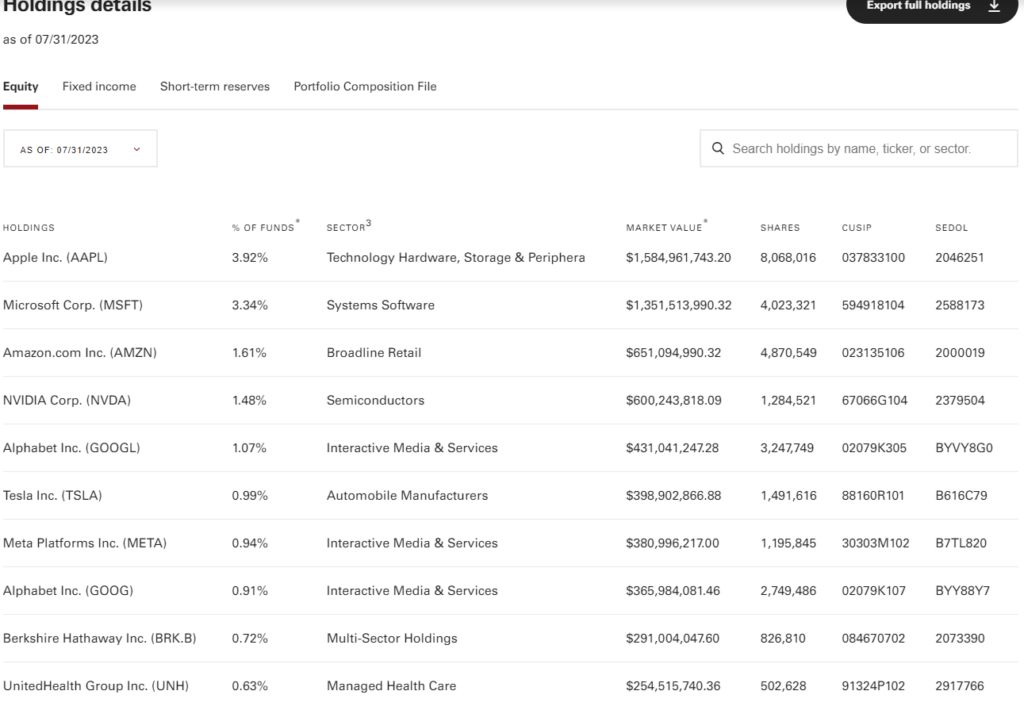
3. Schwab U.S. Dividend Equity ETF (SCHD)
SCHD has a bit of a reputation on YouTube. Many thought it was the “perfect” ETF, but it has lagged behind the S&P 500 this year.
The selection criteria for SCHD is a bit different than DGRO:
- 10 consecutive years of dividend payments
- Minimum market cap of USD $500 Million
- Minimum average daily traded value of USD $2 Million
Then, the stocks are sorted by yield. And then only the top half of these stocks are eligible to be included in the index.
Then, this list is further reduced by sorting stocks by four factors considered equally: free cash flow to debt yield, return on equity, yield, and five-year dividend growth rate.
Finally, only the top 100 stocks from this list are selected for this index.
I like the idea of SCHD because they filter for companies with profits, free cash flow, and dividend growth.
So, a company can have a high yield, but if they borrow money to pay that dividend, they aren’t included. Or if they aren’t in the top 50% of dividend payers, they aren’t included. Apple is not on this list, for instance.
The 1-year return has been 5.4%, and the trailing yield has been 3.4%.
This stock has been underperforming in the past 12 months. But I don’t care. The companies on this list are generally strong financially and can be expected to pay a dividend in the future.

2. Hamilton Enhanced Multi-Sector Covered Call ETF (HDIV.TO)
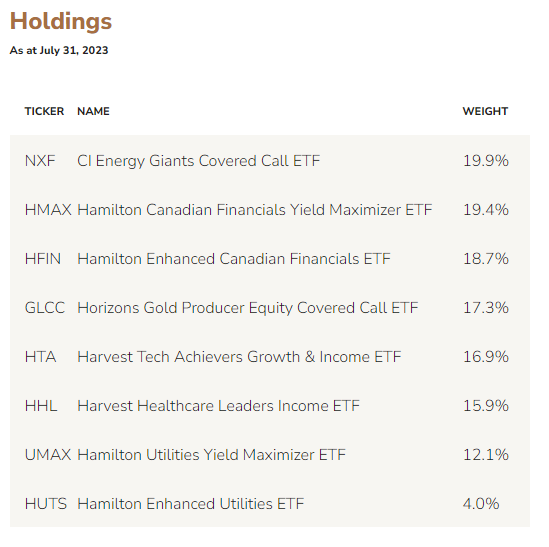
HDIV is a high-dividend ETF that uses leverage and invests in covered call ETFs. It also has some Canadian exposure, unlike DGRO and SCHD.
The 1-year return has been 11.3%, and the trailing yield has been 10.54%.
This is a bit of a risky play. This ETF only makes up about 10% of my total invested portfolio. But it has a massive 10% yield and is fairly well diversified into energy, financials, gold, tech, healthcare, and utilities. These stocks aren’t covered by the other funds I am invested in, except the total world funds.
1. Vanguard FTSE All-World ETF Accumulating (VWCE)
I don’t mention this often, but I have some money in Europe. Getting that transferred to Canada for the sole purpose of investing is a bit of a hassle. So I need a solution to invest the money in Europe.
Finding ETFs in Europe is tough. Luckily, there are a few that are decent. And this is one of them.
My number one holding is VWCE.
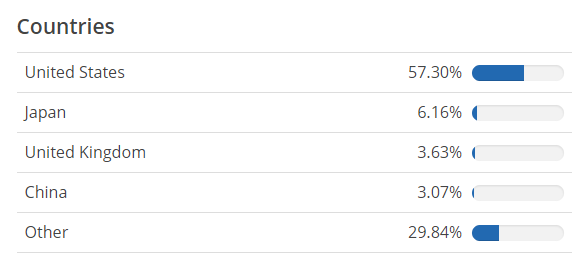
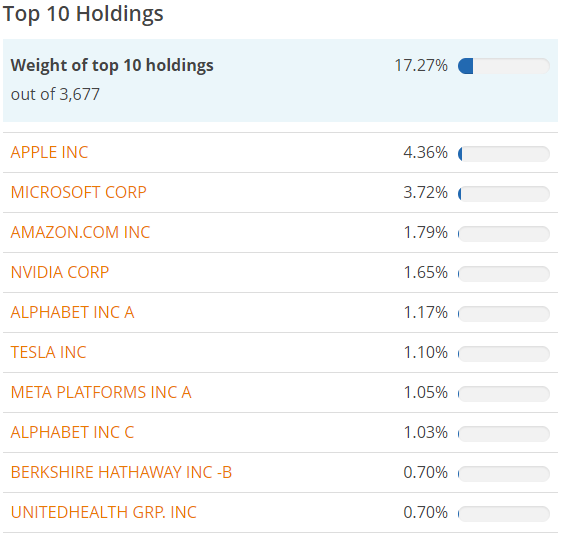
This is similar to VT I guess. It holds 3,677 stocks from around the world. And is well diversified globally.
The FTSE describes this index as being large-cap and mid-cap. So obviously this index doesn’t include small-caps and micro-caps.
There is a filter on these stocks, so it holds fewer stocks than the Vanguard index. One important filter is that there is a minimum market cap to reduce the number of small companies in the index. This reduces turnover and reduces fees. For instance, for a new stock to be included in the index, it has to have a market cap of $150 million. And stocks that fall below a $30 million market cap will be removed.
The 1-year return has been 3.2%. There’s no dividend since it’s an accumulating fund.
Some Observations
Some of these funds have the same stocks. Microsoft, Apple, Abbvie, Chevron – these are some of the top market cap stocks in the world. And so they feature prominently in these passive ETFs.
As a passive fund, there’s almost no way around this. They have to follow an index, which has to be algorithmic. An active fund might be able to find an undervalued company and bet big on it. But an index has rules and must follow those rules.