Thinking More About YieldMax
FOUR PERCENT of my overall investments are currently in YieldMax ETF products. That might not sound like much, but like some super hot sauce, a little goes a long way.
That 4% of my assets currently provides 44% of my portfolio income as monthly distributions.
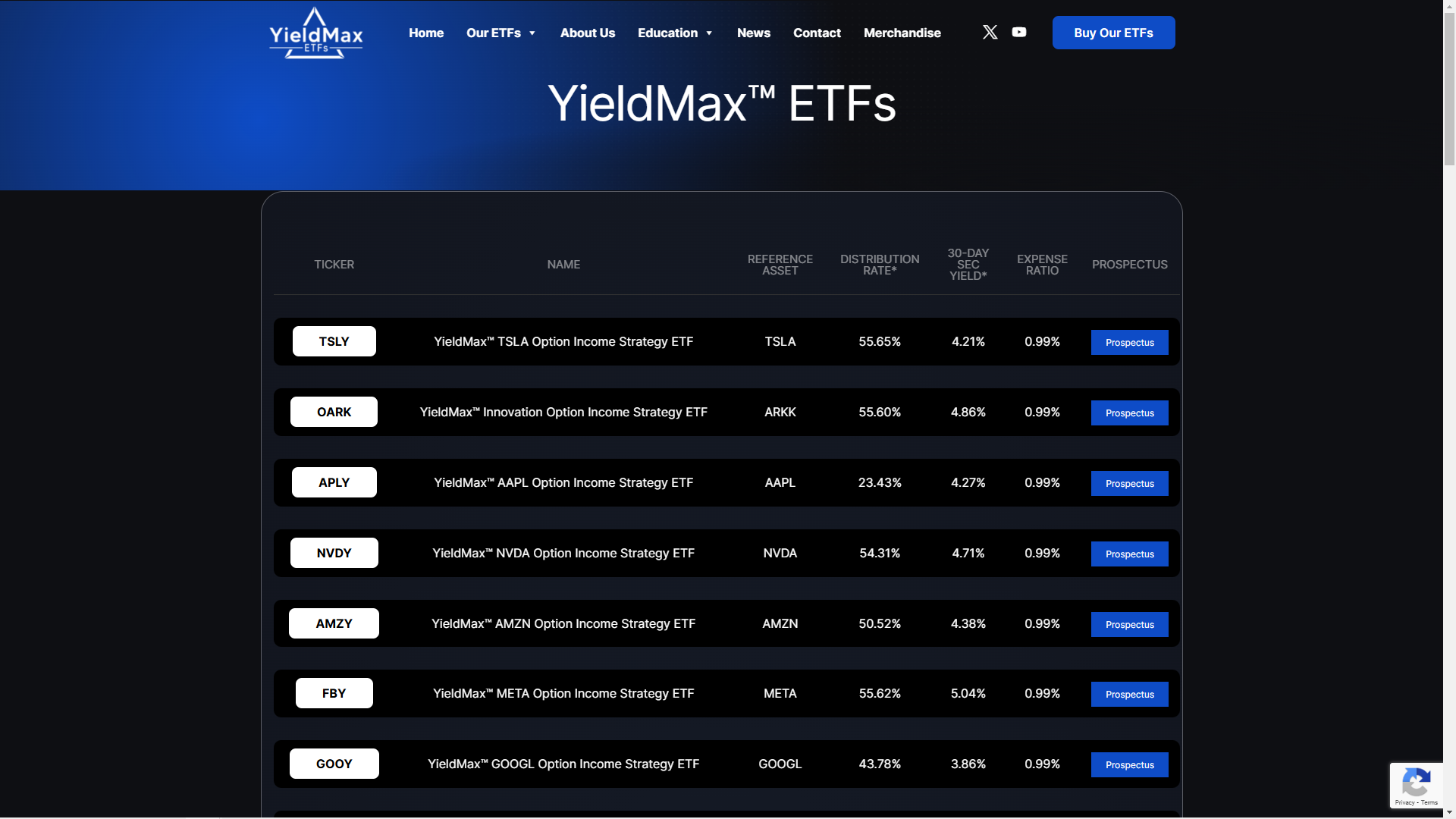
The average annual return on investment of those YieldMax funds is 48%. 48%! If risk and reward are related, I am apparently taking a massive risk with that 4% of my portfolio!
How Does YieldMax Work?
So first, a bit of background.
YieldMax uses a synthetic covered call strategy on a popular underlying stock. This means that it purchases call options at one strike and sells call options at a higher strike. It pockets the premium as income. The options premium is generally high if it does this on a very volatile stock. If it does this on a stock that goes up in price, it generally gets to keep the options premium as well as the difference in the two strikes.
The stocks that I own YieldMax ETFs on are:
- GOOGL – Alphabet (Google)
- META – Meta (Facebook)
- MSFT – Microsoft
- TSLA – Tesla
- AMZN – Amazon
Four of those five companies are really good, and I believe in their products. One is just extremely volatile and is led by a CEO who intentionally chases controversy.
So far, I am generally profitable with these ETFs. Amazon and Microsoft have done really well and are up 30% for me. Google and Facebook are also profitable. Tesla was a terrible idea to invest in.
I don’t regret buying TSLY as part of this experiment. I was looking to take some risk. I will have to hold onto it for a couple of years and collect the distributions. As long as the price doesn’t keep falling.
The real risk of these ETFs is if the price falls and never recovers.
Here’s a hypothetical example:
STOCK – $20 per share
DIVIDEND – $0.20 per month (1%) or $0.24 per year (12%)
Let’s assume something bad happens to the company, and the stock drops 50%.
STOCK – $10 per share
DIVIDEND – $0.20 per month (2%) or $0.24 per year (24%)
You might think, oh great! The dividend is now 24%!
But it’s not. As you OWN the stock at $20, your rate of return doesn’t change – 12% per year.
However, at $10 NAV, the assets of the ETF have been cut in half and the fund managers can no longer earn a reliable $0.20 per month! So they are forced to drop the dividend to $0.10 per month.
STOCK – $10 per share
DIVIDEND – $0.10 per month (1%) or $0.24 per year (12%)
So the ETF can still advertise a high yield, but the people who bought the STOCK before the price drop are invisibly screwed. The sucker who purchased this ETF at $20 is now only making 6% per year.
The real risk of these ETFs is some loss of NAV that causes a long-term drop in the distribution per month. I will have to look out for that.
Hopefully, TSLA can recover or stabilize. For my sake. 🙂